Simon Dickson has been blogging about online government, politics and WordPress since 2005. Some important people read it.


Archive for 'simonwheatley'


Friday 17 February 2012

Free Speech Debate: our most ambitious project ever

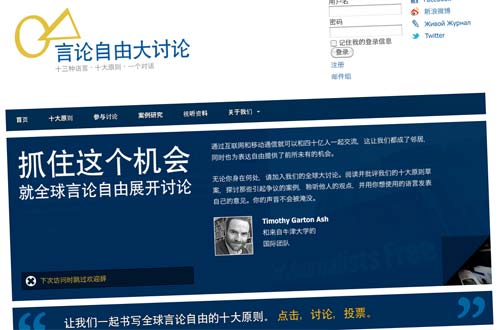
Since last spring, Mr Wheatley and I have been working with Guardian columnist Timothy Garton Ash, in his role as Professor of European Studies at St Antony's College, Oxford on a project called Free Speech Debate. It's been the main focus of my attention for the last six months or more - which explains why the blog has been rather quiet of late.

As the name suggests, it's a site for editorially-led discussions on issues of freedom of speech, in today's socially-networked world. And as you might expect from someone so well-known and well-connected, the Professor has managed to secure contributions from a host of famous names in the field, from around the world - from Jimmy Wales to Max Moseley, not to mention numerous writers, and the odd Nobel Prize winner.

We've done similar 'editorially-led discussion sites' for numerous clients in the past, but never anything on this scale. You see, one of the site's 'ten draft principles' includes the right to speak in your own language. So we had little choice but to publish in multiple languages. And yes, that includes the difficult ones too.

The site went live initially in English-only. But in the last week, we've rolled out German, Turkish, Spanish and Chinese... with Arabic, Farsi/Persian, French, Hindi, Japanese, Portuguese, Russian and Urdu to follow shortly.

Our original plan was to use the WPML plugin for WordPress: we knew it had weaknesses, but it was the best of a disappointing bunch. However, for reasons I won't go into here, we subsequently decided to write our own plugin, based on modern WordPress features such as custom post types and taxonomies. It's called Babble; and I'm delighted to say, as soon as we've tidied it up a bit, we'll be open-sourcing it.

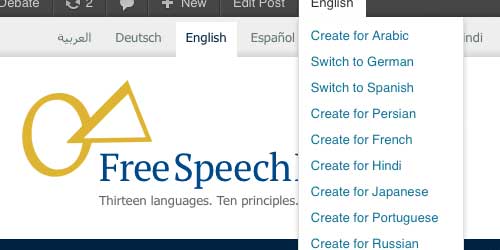
Babble's create/switch menu

The way we've implemented Babble on FSD, you enter each post (etc) in the site's default language first, then - using a menu added to the Admin Bar - you can 'create' a translation in any of the languages you've enabled on your site. All the metadata - taxonomies, comments on/off, and so on - are inherited from the default language; so all you need to do is translate the text, and hit Publish. You'll even see the WordPress admin interface in the appropriate language as you're translating.

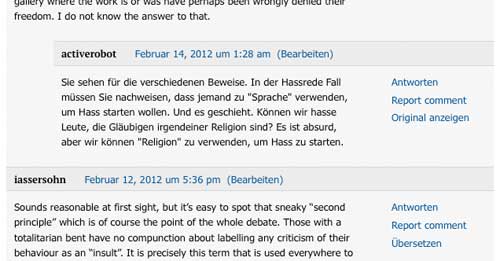
Comments are merged across translations: which means you'll potentially have a discussion thread made up of comments in different languages. Problem? No. We've implemented Google Sectional Translate, to let you translate each comment instantly into the language of the page currently being displayed (via ajax).

English comments on a German page, with "Übersetzen" option

The entire site, in every language, is being generated by the same WordPress theme, be it a left-to-right language like English, or a right-to-left like Arabic. Building bi-directional code has left my head spinning on numerous occasions, I can tell you - and prompted me to write, in effect, my own direction-agnostic CSS framework. If you think that sounds easy enough.... go ahead and try it. Then think about the implications of showing - in some circumstances - content in both right-to-left and left-to-right languages simultaneously on the same page.

Farsi, aka Persian, ie Iranian: note the flipped logo

So much for the translation of page content: what about the stuff that's inevitably hard-coded into the theme? For that, we've used GlotPress - the translation management web app, as seen at translate.wordpress.org. To be completely honest, it doesn't yet feel like a finished product: one bug in particular derailed us for a day or more, and I consider myself very lucky to have found a solution. But when it works, it's excellent.

There's a dedicated section for audio/video content, powered by a custom post type. In fact, this is probably the code which gives me the most pleasure: to post a video, all the editor needs to do is paste in the URL of its YouTube page, and we do (nearly) everything else automatically - even going as far as pulling the video's preview image into WordPress, and attaching it as the post's Featured Image. For audio clips, we're doing a combination of HTML5 and Flash embedding of MP3 files, to cover as many browsers as possible.

That's not to mention the seamless MailChimp integration on the WordPress register page. Or the voting mechanism. Or the multi-server configuration, in preparation for some anticipated traffic peaks. Or the live webcasting. Or the connections into Sina Weibo, LiveJournal and Mixi, as well as Twitter and Facebook. Or... To be honest, we've been working on it so long, there are probably a few custom features in there that I've completely forgotten.

It's unquestionably the most ambitious project I've ever taken on: and seeing it launch this week has prompted feelings of pride, anxiety and relief in almost equal measure. I now know more about quotation marks, soft hyphens and non-Latin typography than I probably ever wanted to know.

Thanks go to Timothy, Maryam, Judith and the entire team at Oxford; Matt and Gemma for design assistance at various stages; Jools for his customary server wizardry; and Simon W, without whom...

Oh. Next week, we have our first scoping meeting for Phase Two. Gulp.

Monday 26 April 2010

Taking Slugger O'Toole to the next level

If you have any interest in Northern Ireland politics, you'll be familiar with Slugger O'Toole. It's by far the best known blog in the province, and manages to pull off the impressive feat of appealing to both sides of the sectarian divide - even to the point of winning awards at ceremonies in both the UK and the Republic. And as an Ulster exile myself, it's a site I've followed for a long, long time.

Late last year, Slugger received investment from Channel 4's 4iP fund, to take things to the next level. In practice, that meant an update to a design that was really showing its age; and a move from Expression Engine to WordPress. But things didn't work out with their initial Belfast-based designer; and a few weeks ago, they got in touch to see if Puffbox could help. The no1 website from my part of the planet, wanting to move to WordPress? How could I possibly refuse?

The brief was to reflect the rough and robust nature of the site's conversations; and pretty quickly,we found a visual style which seemed to strike the right note. But when it came to wireframing, we hit an interesting question: did Slugger want to be more of a blog or a news site?

Our initial templates were definitely more bloggy in nature, but they just didn't feel right. Like a lot of sites, Slugger's traffic has always been driven by news events. And as I think I'd always suspected deep down, we eventually concluded it had to be more newsy - and started again.

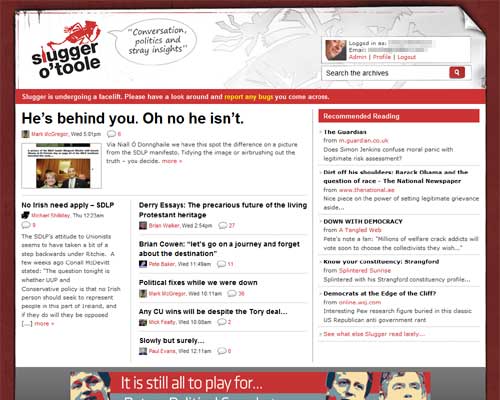
Most of the effort went into the homepage - and specifically the opening frame (or two), which could well be from a newspaper site, if it weren't for the 'torn edges' effect. And therein lies the aspect of the project I'm most proud of: the self-managing 'front page'.

If it was a newspaper, it would have an editor (or probably several) tasked with choosing the right order for the stories, tweaking the headlines, crafting snappy summaries, selecting suitable imagery, and so on. But Slugger is run by a loose bunch of volunteer contributors, and couldn't commit to that kind of management overhead. So instead, we've programmed WordPress to select the stories, and sort them, based on a number of predefined rules.

It selects stories based on their date of posting, the editor's manual identification of 'important' stories, whether or not it's got pictures, and most interestingly, the volume of comments. So a story will almost always get some top-of-page exposure when it's first published, but will soon drop 'below the fold'. However, if it generates a good number of comments, it will jump back up to the top - and in all likelihood, even higher than before.

Sure, it's not quite Digg or Google; but I think it's interesting that the site's readership can influence the homepage almost as much as the editor. And it seems entirely in keeping with the ethos of a site whose true strength is in its sense of community.

On the technical side, it's been really pretty tricky. Thousands of already-registered users, tens of thousands of posts, hundreds of thousands of comments - and the server procured by our predecessors on the project just wasn't up to the task. Things were agonisingly slow on launch day, no matter how many magic tricks Simon Wheatley performed: so we had to make hasty plans to move it somewhere beefier (and as it turned out, cheaper). Thankfully though, we seem to be in calmer waters now.

Knowing the Slugger readership as I did, I feared the worst when it came to reader feedback. In fact, it's been overwhelmingly positive. People seem to like the visual approach, and appreciate what we're trying to achieve with it. We're fixing the (relatively few) bugs which have arisen, and the contributors are getting used to the new interface and the new functions at their disposal. And of course, this is really only the start: having moved everything over into WordPress, all sorts of possibilities now open up.

Several gold stars go to Simon Wheatley, for going far beyond the call of duty on this one; and thanks to Matt at Dunston Graphics, for getting the design just right, and coping admirably with my outrageously late change of strategic direction.

Tuesday 30 March 2010

Live text commentary in WordPress

I don't usually blog about projects until after they've happened; but I'm going to make an exception for something that's going to happen later today.

For just about a year, we've been looking after the website for The Big Care Debate, the government's large-scale consultation on the funding of long-term social care. We've had a great relationship with the team at the Department of Health, and we've done some fun, innovative and highly effective things: commentable documents, Facebook activity, online questionnaires, even user-submitted photo galleries.

The consultation process is reaching its conclusion, with the publication of the government White Paper on the subject. (For those who don't know the jargon: a 'green paper' presents options or starts a debate, often leading to a 'white paper', which is a declaration of government policy.) Oh, and as you might have noticed, there's an election on the cards, and we've already had a few skirmishes on this very subject.

When we first met to discuss plans for the White Paper publication, one idea was to 'live tweet' the launch event on Twitter; but I've never been a fan of sudden, frantic bursts of tweeting by one of the hundred-odd accounts I follow. (And indeed, I've 'unfollowed' certain people for doing precisely that.) So we reworked the plan, taking as our inspiration the undoubted success of the BBC's 'live text commentaries' - seen at its best on the sports site on a Saturday afternoon, but used with increasing frequency on the news site, for set-piece events like PMQs.

So over lunchtime, we'll be supplementing our live video stream with a live text commentary - using ajax and some custom WordPress wizardry. It's a very simple concept at heart. A live commentary is just a chronologically-presented series of short text chunks... just like a list of comments on a post. So that's what we're going to use.

The site editor will be entering his comments via a hidden, ajax-powered comment form: and, as with any WordPress comment, he'll benefit from features like automatic text formatting, including conversion of URLs into clickable links. Meanwhile, users will see each new comment appended to the bottom of the list, with a cute colour highlight, but without the need for a full page refresh.

Naturally, this means a much increased workload for the web server, particularly if - as we expect - we attract a sizable audience for what looks like being front-page news. WordPress and its plugin collection can do a lot to help; but we've taken a few additional server-level steps to ensure all runs smoothly. All the credit for this goes to my regular collaborator Simon Wheatley, who knows a thing or two about these things, thanks in part to his work for Stephen Fry.

There are plenty of options for running live text commentaries like this, such as the excellent CoverItLive. But there are a number of benefits to running it within WordPress: not least the fact that afterwards, you'll instantly have a bullet-point summary of the key points at your disposal. And as we've been building the functionality, we've been getting quite excited at other ways we could use it.

If you're at a keyboard at lunchtime, please drop by, and let me know how you find it.

Friday 30 January 2009

DFID's new group blog function

dfidgroups

We rolled out a fairly modest enhancement to the DFID Bloggers website this week: probably unnoticed by most users, but one I'm quite proud of. At its heart, the DFID site is a group blog; but we do a few things to present it as a network of individual blogs by individual bloggers. Then the question came - 'could we do a group blog?'

What we've done is effectively hijack WordPress's category functionality, turning it into a grouping function. We've created categories corresponding to the various 'group blogs' we want to run; and with the help of another custom plugin, we've added the ability to give each category its own 'user image', same as we've done with individuals. The WordPress category archive template then becomes, effectively, a 'group homepage' template.

Then, with another plugin, we've added a function to give each individual user a 'default category'. So when they go to write a post, the appropriate category is already ticked - or to put it another way, it's already identified as being for the appropriate 'group'. But as with any WordPress categorisation, you have the option to tick other categories, adding the post to multiple group blogs; or you can untick your default category, if you want to blog in an individual capacity for a change.

Finally, we've changed the homepage code to handle both individual and group blogs. It took a while to get the logic right - but now, you should only ever see one entry per group blog, same as you only see one entry per individual blogger; and it all gets sorted together into reverse chronological order.

The result is a remarkably flexible blogging platform, with the ability to do solo blogs, group blogs, or any combination thereof. And as with the previous DFID work, we're releasing the plugins to the world: the Default Categories plugin should prove particularly useful for people running group blogs.

Once again, it's been a pleasure to work with Simon Wheatley: the man who makes my WordPress dreams come true. And the DFID guys have been great again too, giving us a general steer and letting us work out the best way to do it. I love this project.

Wednesday 8 October 2008

DFID Bloggers: tales from the front line

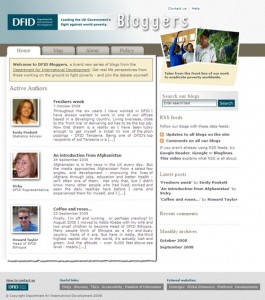
The latest Puffbox project gets a soft launch today, ahead of a formal (and hopefully high-profile) announcement next week. DFID Bloggers is a satellite site off the main Department for International Development website, and follows in the FCO's footsteps of giving front-line staff a blog on which to talk about their work and experiences.

In some respects, it was an obvious thing for DFID to do. Their work isn't generally seen by the UK taxpayers who fund it. By definition, they operate in exotic and/or difficult locations, and have powerful stories to tell. They saw the value in putting some human faces on it all; and in opening lines of communication with anyone worldwide with something to contribute. The Foreign Office had already set a helpful precedent: my brief was effectively 'can we have what they've got, please?'

Using WordPress was, of course, a given; but perhaps surprisingly, I took the decision early on to use the standard version, rather than MU (Multi User). Everyone is effectively writing to the same 'group blog', allowing us to aggregate and consolidate the presentation (eg on the homepage, and in the main RSS feed). But the WordPress approach to output templates allows us to give each blogger a personal homepage, with a fuller biography, a filtered RSS feed and an archive of posts. The best of both worlds, if you like - with fewer concerns about the speed of updates and the compatibility of plugins.

All the standard blog functionality is in there, plus a few things you won't have seen. The homepage shows the latest post for each 'active' blogger; when they haven't written something for a fixed number of days, they'll automatically drop down into an 'archive' list. There's some customisation of the standard WordPress user profile, adding a new 'job title' (ie short biography) field, and incorporating Google Map functionality, for the bloggers to pinpoint their location. This geo-data gets aggregated into a Bloggers Map page, with the popup 'speech bubbles' showing a summary user profile, including a link to their latest blog entry.

I can't say how pleased I am with the results. I've been collaborating with a couple of new contacts - my near-neighbour Tony Parsons on the design side, and Simon Wheatley (who I met at WordCamp) on the technical stuff that was beyond me. Both have been truly brilliant. And I have to say, the DFID guys have been fabulous too - giving me all the freedom I could ask for. It's been a perfect combination, and I think it shows in the site.

In the spirit of open source, Simon W has released the custom WordPress plugins to the world via wordpress.org. In reality, you'll only be interested in them if you're wanting to build a carbon-copy site; but they are now 'out there', and you're welcome to them.

I've also been working with Shane McCracken and his Gallomanor team (including Dave Briggs and Griff Wigley), who have been tasked with training the DFID volunteers in the art of blogging. Judging by the initial posts I've been reading, they've done a great job. I'm sure they will tell their own stories in due course.

Quite honestly, I think it's the best thing Puffbox has yet produced. Great design, great functionality on front and back end, and a client committed to doing it right. With so many great stories and pictures out there, I hope it can have a big impact.

And by the way... it's no coincidence that the site is launching just ahead of Blog Action Day next Wednesday (15 October), when bloggers have been asked to write something about poverty and development issues.