Archive for 'buddypress'
BuddyPress powers new Civil Service community site

There's a new website in the civilservice.gov.uk domain - but because it's at a subdomain, of course, it doesn't count as a 'new' site. (That's an observation, not a criticism; I'm as guilty of doing this as anyone.)
Created by DWP 'in their role as leaders of Govt agile adoption on the ICT Strategy CIO Delivery Board', it's a community site which sets out to provide a space for 'people in the public and private sectors to discuss, share and get advice and answers on adopting agile in UK Government projects'. As such, it ticks a box from the ICT Strategy Implementation Plan.
Naturally I'm delighted to see they've built it using BuddyPress. It looks like a fairly 'vanilla' installation for the moment, running using the free BuddyPress Corporate theme, with minimal customisation. I've also spotted the Q&A premium plugin in there too. The IP address reveals it's the handiwork of Harry Metcalfe's DXW crew.
They're doing the right thing by just charging headlong into it; it seems like all the Facebook-esque functionality - personal profiles, groups, forums (?), friending, etc - has been enabled. Some of it will work, some won't. But since it's all in there already, you may as well give it a try.
I'd also endorse the decision to work with a ready-made theme: I recently looked into developing a BuddyPress theme from scratch, and soon gave up on the idea. It's terrifying. If you really want to customise the look & feel, do it as a Child Theme.
The fate of any BuddyPress is dictated by the momentum it builds (or fails to build). The site, or more accurately its membership, needs to provide good enough reason for people to come back regularly, and contribute while they're there. I wish them well.
We've got a BuddyPress-based government project of our own in the works; the development work is close to completion, but we're facing a few bureaucratic hurdles. I'm hoping for progress in the next couple of weeks; naturally, I'll blog about it in due course.
People like intranets’ names
I've just started work on a project to build a first-ever intranet for a small UK government entity. I've been waiting for ages for an opportunity to put BuddyPress, the semi-official WordPress add-on which promises a 'social network in a box' experience, to the test... and this is it.
It's still early days in the thought process - but the plan is to make heavy use of BuddyPress 'groups', to generate a personalised real-time view of activity in the areas in which you have a specific personal interest. Each team or department would be a group. Each cross-departmental project would be a group. There might also be groups based on physical location, social activity, union membership and so on. Some would be mandatory (eg 'all staff'); some would be open for anyone to join; some would be invite-only, or totally hidden.
The BuddyPress 'activity stream' filters itself automatically according to each signed-in user's group memberships; so your homepage (tbc) view would consist only of updates - news, forum discussions, events, document uploads, new members etc - from the groups you belong to. No two users' views would be identical. It's easy to see how powerful this could be; and in a post-Facebook world, it shouldn't be an unfamiliar concept.
Anyway... I started preparing wireframes yesterday, and hit an immediate question. What should go in the 'logo' space, reserved by convention in the top left corner?
Most intranets I've had the misfortune to use in the past have had names. But I wondered, did people actually use those names when referring to them? When asked 'where can I find that document?', would people generally answer: 'On the intranet.' or 'On [insert name here].'? Personally, I'd instinctively say the former myself; but after 17 years in this business, I'm used to the fact that I'm not 'normal'.
So I asked Twitter. And to be honest, I was surprised by the response.
Almost without exception, people responded that yes, their intranet did have a name... ranging from the fairly dull ('Cabweb' at the Cabinet Office) to the fantastic ('Narnia' at the National Archives!) to the quite unfathomable (one digital agency chose, er, 'Agnes'). And yes, people used the name in common parlance.
One or two people reported failed attempts to name their intranet: but the names they mentioned - '[organisation name] Online', or 'The Hub' - seemed very generic. It's almost as if people will make an effort to use the name, if you've clearly made an effort to make one up. If the name seems half-heartedly conceived, it shouldn't come as a surprise that the staff don't buy into it.
I'm not claiming any scientific validity for these results; but I'm left in no doubt that I'm going to have to think up a name.
Telegraph publishes first WordPress plugin

The Telegraph Media Group began embracing WordPress two and a half years ago: first its blogs were migrated over, then its My Telegraph community. They then began embracing WordPress people, hiring BuddyPress core developer Paul Gibbs, and hosting London WordPress meetups.
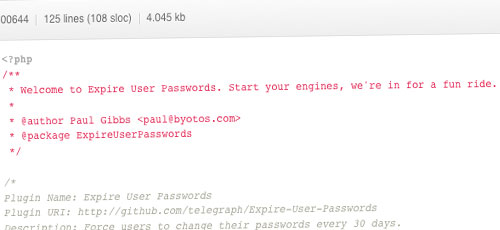
Now they've gone a stage further: releasing a WordPress plugin in the company name. Expire User Passwords has obvious applications in a more corporate environment: it's a zero-configuration plugin which you simply install and forget about. Until you reach the 30-day expiry point, when you're prompted to renew your password.
It's available from the WordPress repository, where it's owned by Paul and a new Telegraph user account. Or alternatively, they've just started making use of a Telegraph Github account which they seem to have registered two years ago.
Well done, Team Tele. Great to see a large corporate giving back to the WordPress community. I'd love to know how they got over the inevitable concerns about plugin support, liability and so on.