Archive for 'mysociety'
Cameron calls for data standards
Of all the topics I might have expected David Cameron to speak in favour of, standardised data formats was not top of the list. So I'm grateful to Nick Booth for pointing to Cameron's speech last Friday to the Conservative Councillors' Association.
At the moment, local government bodies must provide the public with information about the services they provide, what goes on in council meetings and how councillors have voted on specific issues. But the information isn't published in a standardised way. It's impossible for the public, charities or private companies to effectively collate this data, compare and contrast your performance and hold you to account. That's why the Government relies on expensive and bureaucratic schemes to try and hold local government to account.
We will turn that approach on its head. We will require local authorities to publish this information - about the services they provide, council meetings and how councillors vote - online and in a standardised format. That way, it can be collected and used by the public and third party groups.
A very timely call, especially in the light of discussions last week about Harry's consultations site (some of which, I'm told, he's updating manually?!). I particularly like the way Cameron ties this into the tangible benefits for councillors themselves, removing the need for so many performance measurement exercises.
I've had some dealings in this field, particularly during my time with National Statistics. And I'm afraid it's going to be much, much more difficult than Cameron makes it sound. Too many legacy systems, a chaotic approach to statistical geography, and (frankly) too much opposition from statisticians. Very few statisticians appreciate why they do what they do; they just do it. The work takes on an almost monastic purity. They don't trust mere mortals - media included - to represent it properly. I was one of a management team hired to drive a culture change in that regard. Our success was limited.
Cameron's speech focuses on TheyWorkForYou as a role model for data reprocessing; but I'm not sure the comparison holds up too well. A database of numbers would be much more difficult and more sensitive than the absolutes of Hansard: who said what (subject to correction, of course), and who voted how. Realistically we need to get to greater standardisation of process first: starting with defining consistent geographic reasons allowing sensible comparisons over time.
And besides, we haven't done a great job of producing standardised data in RSS format, one of the most simple and straightforward data standards out there.
Consultations supersite mkII
Thanks to Jeremy for pointing out Harry Metcalfe's new 'Tell Them What You Think', the latest mass screen-scraping exercise from the MySociety stable: this time, it's government departments' consultation exercises. I actually met Harry last week, but didn't realise the project was actually 'out there'. It bears all the classic MySociety hallmarks - which Harry should take as a great compliment.
Describing the story so far on the site's own blog, he writes:
A few months ago, I responded to a couple of government consultations and, in the process, discovered there was no way to search all live consultations, or to be alerted when a new one was published. This struck me as more than a little mad.
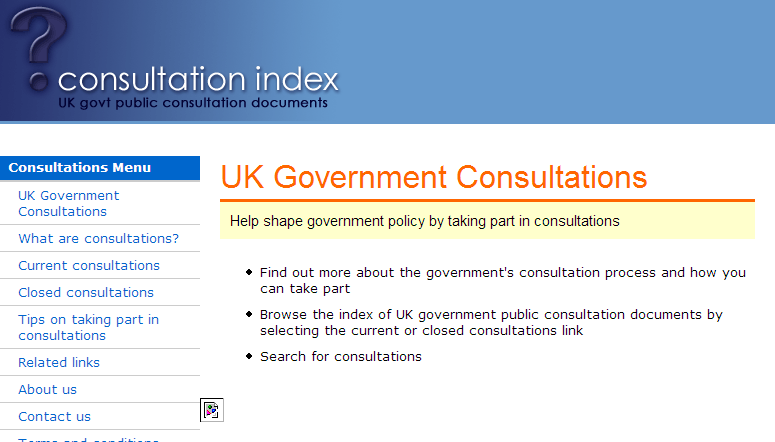
Except that, as web.archive.org demonstrates there was a central site listing live consultation exercises, at www.consultations.gov.uk from 2004 to early 2006. Did the site succeed in encouraging a new wave of civic engagement? Let's put it this way: if it had, why would I be writing this? The site was then taken down, with the address redirecting into the Cabinet Office site.
Today, it redirects to the BERR page on last year's Consultation Policy Review. And - oh! the irony - if you look at their published response, you'll find the following paragraphs:
3.21 Several responses called for a new approach to publicising consultation exercises, including suggestions for a single website for all central Government consultations with a facility to register for alerts.
3.23 The Better Regulation Executive will look into the feasibility of one website indexing all central Government consultation exercises and providing an automated alert system.
Visibility of current consultations is part of the problem, but I'd argue it's a small - and maybe even negligible - part. I'm not even sure we know what they are trying to achieve: is it simply transparency of process? is it just 'what we're meant to do'? are we looking for huge volumes of responses?
And more pertinently, does the government really care what The Masses think? Harry almost acknowledges this himself to an extent, citing an example of a recent consultation which saw 85% outright opposition, and 91% disagreement with the phrasing of the question. What happened? The measure passed anyway.
We need to decide what we're trying to achieve with consultation, then decide the best way to go about it. We're a long, long, l-o-n-g way from there.
But there's one important lesson from the exercise, as Jeremy notes. There are things you can do with your website to help the eage, public-spirited geeks take your information, and do something better with it. Ask them. And next time you spec up a website, make sure there's a section on XML, RSS and/or API.
