Simon Dickson has been blogging about online government, politics and WordPress since 2005.
Some important people read it.


Archive for 'directgov'


Tuesday 23 November 2010

Lane Fox report published; does Cabinet Office share her revolutionary zeal?

Martha Lane Fox's review of Directgov has been published this morning - as an 11 page, 5.7MB graphic-based PDF file, making it impossible to search or select text. (Thanks to various colleagues on Twitter for confirming it wasn't just me.) Its key recommendations, pretty much as anticipated:

  1. Make Directgov the government front end for all departments' transactional online services to citizens and business, with the teeth to mandate cross government solutions, set standards and force departments to improve citizens' experience of key transactions.
  2. Make Directgov a wholesaler as well as the retail shop front for government services & content by mandating the development and opening up of Application Programme Interfaces (APIs) to third parties.
  3. Change the model of government online publishing, by putting a new central team in Cabinet Office in absolute control of the overall user experience across all digital channels, commissioning all government online information from other departments.
  4. Appoint a new CEO for Digital in the Cabinet Office with absolute authority over the user experience across all government online services (websites and APIs) and the power to direct all government online spending.

The document is entitled 'Revolution not evolution' - but that's certainly not the tone of the Cabinet Office press release, which describes the proposals in the most anodyne form imaginable. Where Martha talks about recruiting a 'CEO for Digital', and giving him/her 'absolute' power, the press release talks about an 'Executive Director' - note the immediate switch to Civil Service speak - whose job will be to 'drive change and bring together existing teams working in this area'. And the press release's line about 'asking Directgov and Business Link to create a plan of what would be involved to converge the sites into a single domain' seems two or three steps removed from actually demanding that it happens pronto.

The most provocative proposal in the document is surely the plan to consolidate everything into Directgov:

A new central commissioning team should take responsibility for the overall user experience on the government web estate, and should commission content from departmental experts. This content should then be published to a single Government website with a consistently excellent user experience.

Ultimately, departments should stop publishing to their own websites, and instead produce only content commissioned by this central commissioning team. There is no need for a major migration of content from existing departmental websites, they should simply be archived or mothballed when essential content has been commissioned and included in the new site.

But Francis Maude's letter in response - quite rightly - takes a very cautious view of the work involved, and its implications... and almost seems to be kicking it into the long grass.

I agree in principle with your proposal that over time Government should move to a single domain based on agile web shared web services. However, as your report makes clear, this will be challenging for Government and I will need to consult colleagues before we make a final decision about how to proceed. To take these and other cross government issues forward, I intend to set up a new Ministerial Working Group on Digital reporting to the Cabinet Economic Affairs Committee.

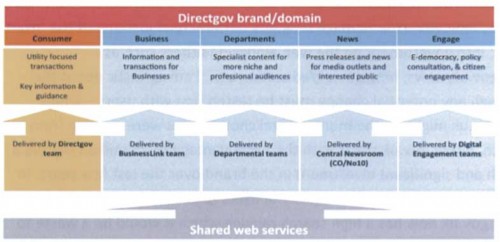
Notable by its absence from the review is NHS Choices. Martha's 'shared service' vision shows Directgov, Business Link, 'departmental teams', a Central Newsroom (CO/No10) and 'digital engagement teams' all feeding the Directgov brand/domain - but there's no reference to the third of the three supersites. I spotted the other day that NHS Choices is being openly reticent about getting involved in the G-Digital project: the one-page overview on the G-Digital site notes that 'NHS Choices are represented on the G-Digital Project Board and are considering how they can best utilise the project.'

And whilst the Maude response talks about 'simplifying the governance of Directgov', there's no specific reference to the fate of its management board.

That's my report on the publication itself; I'll reflect on the proposals later. In the meantime, here's what Steph Gray thinks... and he's bang on.

Comments: 3

Monday 22 November 2010

Lane Fox plans for government web revealed

A document published on a non-departmental gov.uk site appears to have lifted the lid on Martha Lane Fox's plans for UK government web publishing. The document, published as an unrestricted PDF, is a review of the website of the organisation in question. But given the ongoing Lane Fox review, its author provides a helpfully concise summary of what may lie ahead.

[Lane Fox] is recommending that Directgov should expand in scope to become the government front end for all transactions, with the ability to mandate departments to meet standards they set; she is also recommending the establishment of a central team in the Cabinet Office in charge of commissioning all online government information, led by a CEO for digital to direct all online government spending. There has been no formal response from the Government to her proposals, but it reflects an overall trend for centralisation and standardisation of government online information and services.

A copy of Lane Fox's letter to Francis Maude, dated 16 October, was attached to the document in question; but, sadly, has not been included in the online copy. It does at least indicate that the plans have already been widely circulated around the Civil Service.

For the record, the PDF in question appears (at the time of writing) in the first few pages of Google search results for 'martha lane fox directgov review'.

Comments: 7

Sunday 21 November 2010

Directgov board ‘dissolved’ prior to CEO’s exit

In the world of the government webby, it really doesn't come a lot juicier than this. Jayne Nickalls's resignation as chief executive of Directgov was confirmed via Twitter on Saturday:

[blackbirdpie url="http://twitter.com/#!/jnickalls/status/5971161754107904"]

This was followed by a report in the Sunday Express (which I'd have missed, were it not for a helpful tipoff):

THE boss of a major Government website has quit amid concerns about a “politicised power-grab” by David Cameron’s spin doctors. Jayne Nickalls, the chief executive of Directgov ... left last week. The organisation’s board has also been dissolved before an announcement about the website’s future due on Tuesday.

I'd heard rumours about the board's dissolution: so I contacted Rory Sutherland, a man who knows a thing or two about public relations, who was appointed as a non-exec director in 2008.

[blackbirdpie url="http://twitter.com/#!/simond/status/5961035764736000"]

[blackbirdpie url="http://twitter.com/#!/rorysutherland/status/6347334073978880"]

Beautifully worded.

Directgov itself has virtually no information about its own board. So I'll have to quote a COI press release from 2008, which says the board existed for the following purposes:

  • Contributing to and approving an annual business plan to meet the requirements of the annual remit letter;
  • Agreeing strategies for the delivery of the business plan, priorities for delivery and the allocation of resources;
  • Setting the standards and values of the organisation;
  • Agreeing annual KPIs for Directgov and regularly monitoring performance against them; and
  • Ensuring achievement of Directgov's targets associated with the cross-Departmental Service Transformation Delivery Agreement.

Now... you could certainly put two and two together here, with the proposal that all government (ie policy / political) material should be merged with Directgov's rather clinical information, and the protective layer of the board being removed, to conclude that Jayne had walked out as a direct consequence.

I stress, I don't know if this is or isn't the case: but you'd certainly understand if she felt this would jeopardise, and potentially compromise the 'public services' brand she'd worked hard to develop over the last five years. And stripping away the board, quite abruptly from what I'm hearing, can only have heightened any concerns she might have had.

Have a good week, gang.

PS I'll also note in passing the piece in the Observer today: 'Britons will be forced to apply online for government services such as student loans, driving licences, passports and benefits under cost-cutting plans to be unveiled this week... Cabinet Office officials say the full savings will only be felt if everything is moved online. Leaving even a small percentage of print registrations would be "prohibitively expensive".' Although there isn't even a namecheck for Directgov itself, it's an illustration of just how central it is to the government's overall cost-cutting drive.

Comments: 2

Friday 19 November 2010

Directgov CEO Jayne Nickalls quits (now confirmed)

No formal confirmation as yet, but we have reports from two very well-placed sources that Directgov CEO Jayne Nickalls has 'resigned' from her £95,000-a-year position.

[blackbirdpie url="http://twitter.com/markflanagan2/status/5657033491611649"]

[blackbirdpie url="http://twitter.com/JimmyTLeach/status/5672929454981120"]

It's just over a month since Martha Lane Fox submitted her review of Directgov, and her proposals for its future. And only two days ago, there was the clearest confirmation yet of the whispers I was picking up, when Civil Service Live posted a report that Directgov is to be government's sole website.

More to follow - but since it's well after 5pm on a Friday afternoon, I wouldn't exactly hold your breath.

Comments: 2

Friday 12 November 2010

Cabinet Office web ‘takeover’

Leaving aside the inevitable tabloid hyperbole, the Mirror is reporting this morning that:

Scores of civil servants could be axed under plans to hand David Cameron's "vanity staff" control of all Government websites. The PM wants to create a single unit to take charge of web operations handled by 117 staff in separate departments. Whitehall's dozens of official websites could be merged into one in a cost-cutting measure which would also allow Mr Cameron's aides to "brand" the coalition's presence on the internet. Former Tory party staffer Rishi Saha, who oversees No10's internet site, is expected to be in charge.

That would certainly be in keeping with the signals I've been seeing over the past few weeks.

Comments: 8

Tuesday 9 November 2010

What are you suggesting, Sir Bonar?

There have been some intriguing tweets from the well-connected, albeit fictional, UK data sharing czar, Sir Bonar Neville-Kingdom in the last day or so.

[blackbirdpie url="http://twitter.com/sirbonar/status/1689062737977344"]

[blackbirdpie url="http://twitter.com/sirbonar/status/1712500290617345"]

[blackbirdpie url="http://twitter.com/sirbonar/status/1713718299721728"]

There it is again: the notion of greater rationalisation around Directgov. Hmm..?

In other news: Guido Fawkes is getting his teeth into the number of former Conservative Party (and indeed, Lib Dem) staff now finding themselves with Civil Service jobs. One stand-out name on the list is Rishi Saha, whose appointment was (finally) covered by the Mail a few days ago. Newsnight's Michael Crick quotes his job title as 'deputy director of communications in the Cabinet Office (and effectively head of digital communications, in charge of the websites run by the Cabinet Office and Number 10)' - but he isn't named in the Cabinet Office's recent orgchart.

Add a comment

Thursday 21 October 2010

Lane Fox review hints at further rationalisation

Martha Lane Fox's review of Directgov appears to have taken a slightly wider view than simply how well everyone's favourite orange website works. Speaking at a conference in Birmingham, Cabinet Office director of digital delivery Graham Walker said:

We've been doing a review of Directgov and most of government on the web. We can see that there is a need to massively simplify it, with a lot more rationalisation and to improve the user experience.

Most of government on the web? More rationalisation? I've been hearing rumours that Ms LF's recommendations may include a stronger role for Cabinet Office in departmental / policy publishing, much as it already has (through Directgov) in citizen-facing material. Are we looking at a single super-site for departments?

On a superficial level, that's a return to the Dark Ages of 1994, when departments used to send floppy disks in the post to Norwich, where someone from CCTA would mark them up into HTML, and FTP them over to the Government Information Service (aka open.gov.uk). It's also a return to the expensive and ultimately unsuccessful notion of The Club / DotP, which would have seen all departments running on the same (bespoke) CMS as Directgov and DH.

But a lot has changed in the past year or two - and it's possible to envisage more modern publishing infrastructures, based on a managed multisite approach. You can look at what we've done on WordPress for Defra as an example: a centrally controlled environment, with the root level defining aspects like primary navigation and plugin selection, but with a high degree of flexibility and freedom given to the various child sites.

So yes, I can see why such a move would seem desirable - Directgov has been a success, at a very high price of course, and consistency of presentation and UX wouldn't be a bad thing. (Indeed, I've written here previously, in praise of greater presentational consistency.) And yes, I believe it's now technically realistic, in a way it never was before.

The precedents give plenty of reason to be pessimistic, though.

Comments: 1

Thursday 29 July 2010

Directgov’s £28m/yr to be cut by a third

For those interested in the move of Directgov, and its 172 FTE staff, back to Cabinet Office control, there's loads more detail in an explanatory document published on the Parliament website. I say 'published': it's been slipped out as a PDF on the little-known deposits.parliament.uk subsite.

The note confirms that 'Directgov funding will be reduced by a third over the Spending Review period', from £28.4m in 2010/11, 'together with the funding for the digital teams based in the Cabinet Office.'

But alongside the nuts-and-bolts details of who pays for the laptops, there's an interesting perspective on what Directgov's actual role is:

Directgov‟s ongoing role is to enable government to:

  • Reduce the deficit
  • Encourage individual and social responsibility, through provision and sharing of information and services in an open and transparent way
  • Enhance the role of social enterprises, charities and co-operatives in public services

Add a comment

Thursday 22 July 2010

Directgov returns to the Cabinet Office

I couldn't help smiling at the news of Directgov going back to its original home in the Cabinet Office. Funny how things go full-circle: launched from within the Cabinet Office in April 2004, to COI (an 'ideal location') in March 2006, to DWP in April 2008, back to Cabinet Office in July 2010.

The Cabinet Office press release says it will 'sit in the Government Communications team headed by Matt Tee', with oversight from Francis Maude and Danny Alexander; but will also have celebrity input:

Today’s move puts new energy behind the drive to get more people and public services online. Martha Lane Fox, UK Digital Champion, will drive a transformation and redirection of Directgov as part of her role advising government on how efficiencies can best be realised through the online delivery of public services.

That's quite a curiously worded sentence when you look at it. In terms of traffic at least, Directgov is doing well - so you could argue that a 'transformation and redirection' of Directgov would be breaking what has so far been a winning formula. But then comes the key word - 'efficiencies'. I think we know what that means.

And so, Directgov continues to be shuffled around government every two years. But maybe now, with Matt Tee's Cabinet Office government communications unit holding responsibility for all the key strands of activity, it'll get the kind of clear, authoritative leadership it's perhaps been lacking.

Let's all meet up again here in 2012, and see how it went.

Add a comment

Thursday 24 June 2010

Remember to say thank-you

A bit of a tricky moment this morning. As you might have spotted, Downing Street has launched an initiative asking 'public sector workers' to help the government find ways to implement the massive spending cuts proposed in Tuesday's budget 'in a way that is fair and responsible'. And as has become the norm for such initiatives, there's a comment-enabled website dedicated to it, built on WordPress. A 'hooray' is obligatory at this point, although to be honest, that's getting a little predictable. ;)

In fact, it's a return to an initiative launched by Nick Clegg last summer:

The people who are best placed to tell us where money is not being well spent are the teachers, nurses, social workers and other public servants who work so hard day and night on our behalf. Politicians should stop talking over the heads of public servants. We need to listen to the people in the know on how we can better run public services, making sure that every penny of taxpayers’ money is well spent. That’s what ‘Asking People In The Know’ is all about.

... but since it's all happening again, and since the 2009 website is now giving 404 errors, one must assume it wasn't especially fruitful.

Anyway... If you have a look at the new website, you'll note a startling resemblance to the Programme For Government site which I built a few weeks back. It's very obviously a derivative work, based on my code. I didn't build it, and I didn't get paid for it. My contract gives the Crown the right to reuse my work; and in fact, I'm very glad they did. It's entirely in keeping with the open-source spirit... not to mention the need to find cost savings.

But as anyone following me on Twitter may have spotted, there was one slight hiccup. By convention, WordPress themes include details of their author. The original PFG theme notes me as its originator - obviously. But the derivative theme didn't. My name had been deleted, and replaced with the names of two people I've never met or spoken to: at least one of whom appears to be a direct commercial competitor.

I was not best pleased. I sent out a tweet to that effect: and to the credit of one of the individuals concerned, he subsequently added a line of acknowledgement. My name is duly checked, and I'm happy again.

I am absolutely not suggesting there was any attempt to infringe my intellectual property rights, or deprive me of a deserved payment. I'm perfectly prepared to accept that it was a simple oversight. But I needed to make the point.

Acknowledgement is the currency of the open source movement. There are communities of developers spending their free time building these tools, not to mention businesses freely handing over the fruits of their labours, resulting in you getting phenomenally powerful tools for £0.00. Saying 'thank you' is really the least you can do; and it's often the only 'payment' that the open-source contributor receives. Don't forget.

Not for the first time, Steph Gray lays down a good model to follow. On every page in his Commentariat theme is an explicit credit for the Whitespace theme by Brian Gardner; and there's a note of thanks to my regular collaborator Simon Wheatley in its style.css file.

And in case anyone's interested: yes, I do plan to write something for the consultation - it's also open to 'private sector partners working within public sector'. Now, I wonder what I might propose?

Comments: 2